What Actually Happens When a Fibre Is Cut: Four Stages From Alarm to Restored
Detection, fault location, splicing and testing. The real sequence behind every fibre repair, what each stage involves, and which one is almost always the reason it is taking so long.
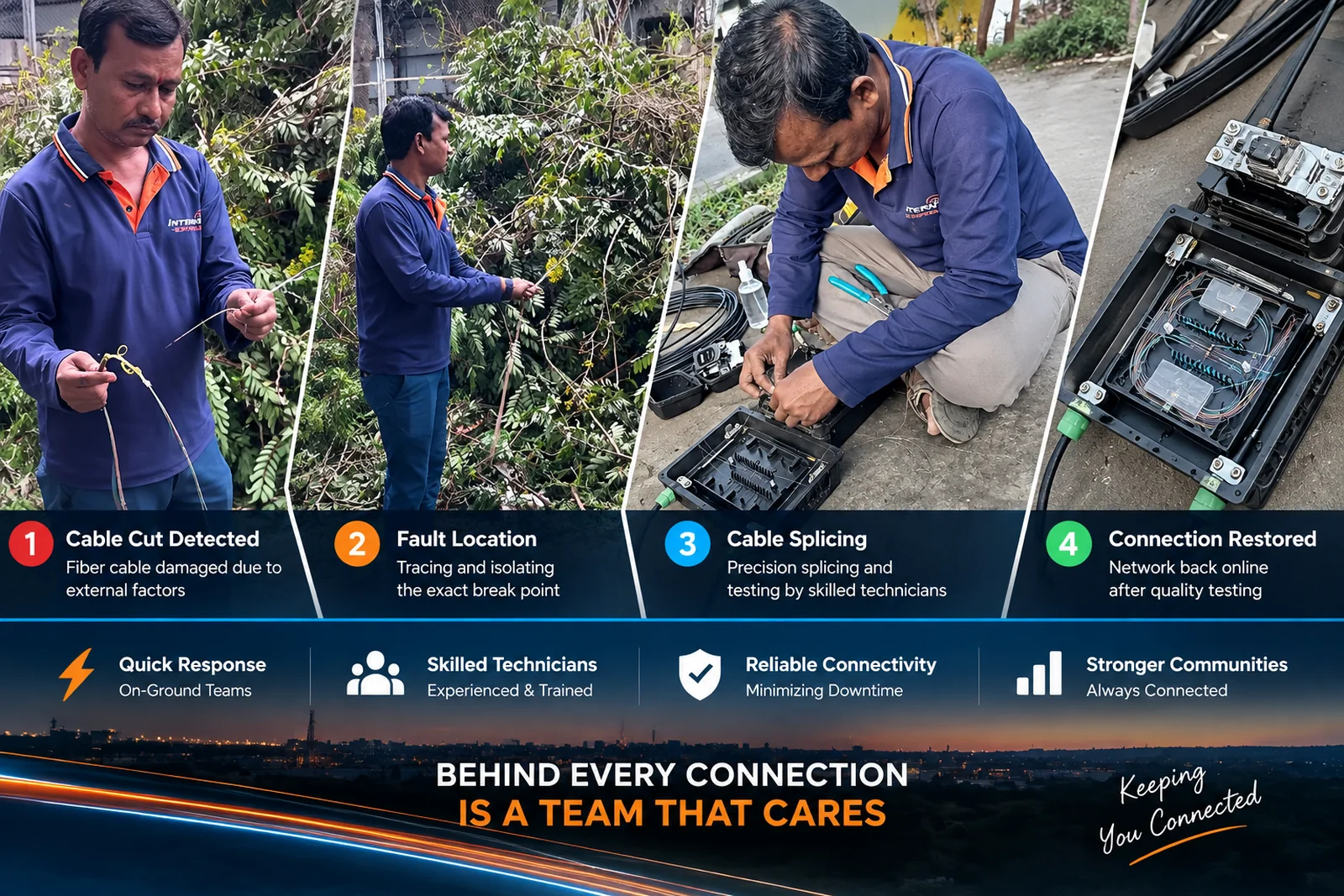
When your connection drops because a cable has been cut, the question everyone asks is "how long?" The honest answer depends on which of four stages is taking the time. Knowing them makes the wait easier to understand — and shows why one of them is almost always the slow part.
Stage 1 — Detection
A fibre network knows when light stops arriving. Our network operations centre watches equipment and link signals continuously, so when a span goes dark the affected section usually shows up before the first customer calls. The pattern of what has gone down also tells engineers roughly where to look: if every connection behind one distribution point drops at the same moment, the break is somewhere between that point and the equipment feeding it.
Your report still matters. It confirms which addresses are affected, flags any single-home faults the network view cannot see, and starts the ticket that any downtime credit is measured from.
Stage 2 — Fault location
Knowing a span is broken is not the same as knowing where. A cable can run for kilometres along poles, trees and ducts. Engineers use optical test equipment that sends light down the fibre and measures where it is reflected back — which gives the distance to the break from the test point. Combined with knowledge of the route, that narrows the fault to a stretch of road.
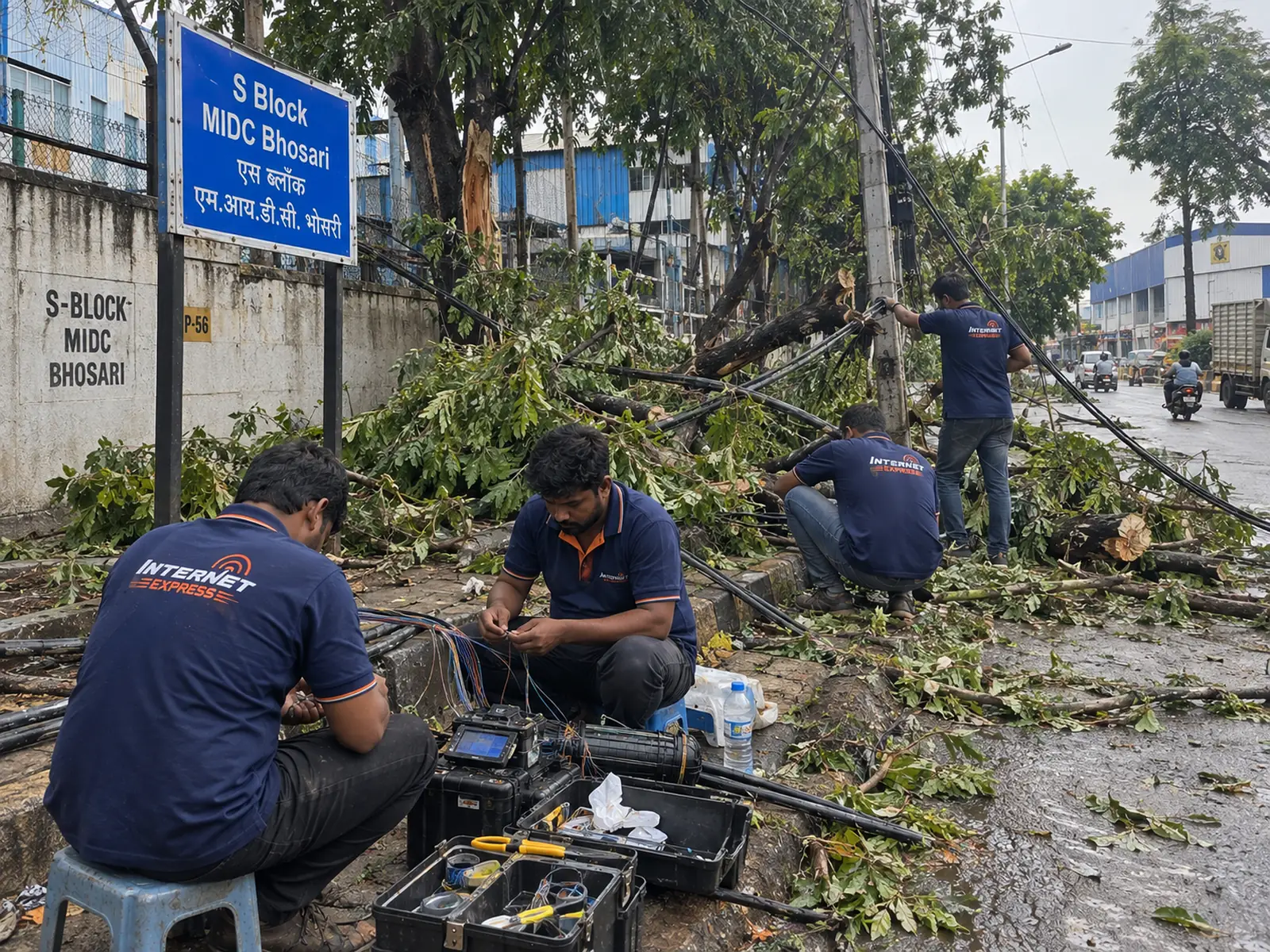
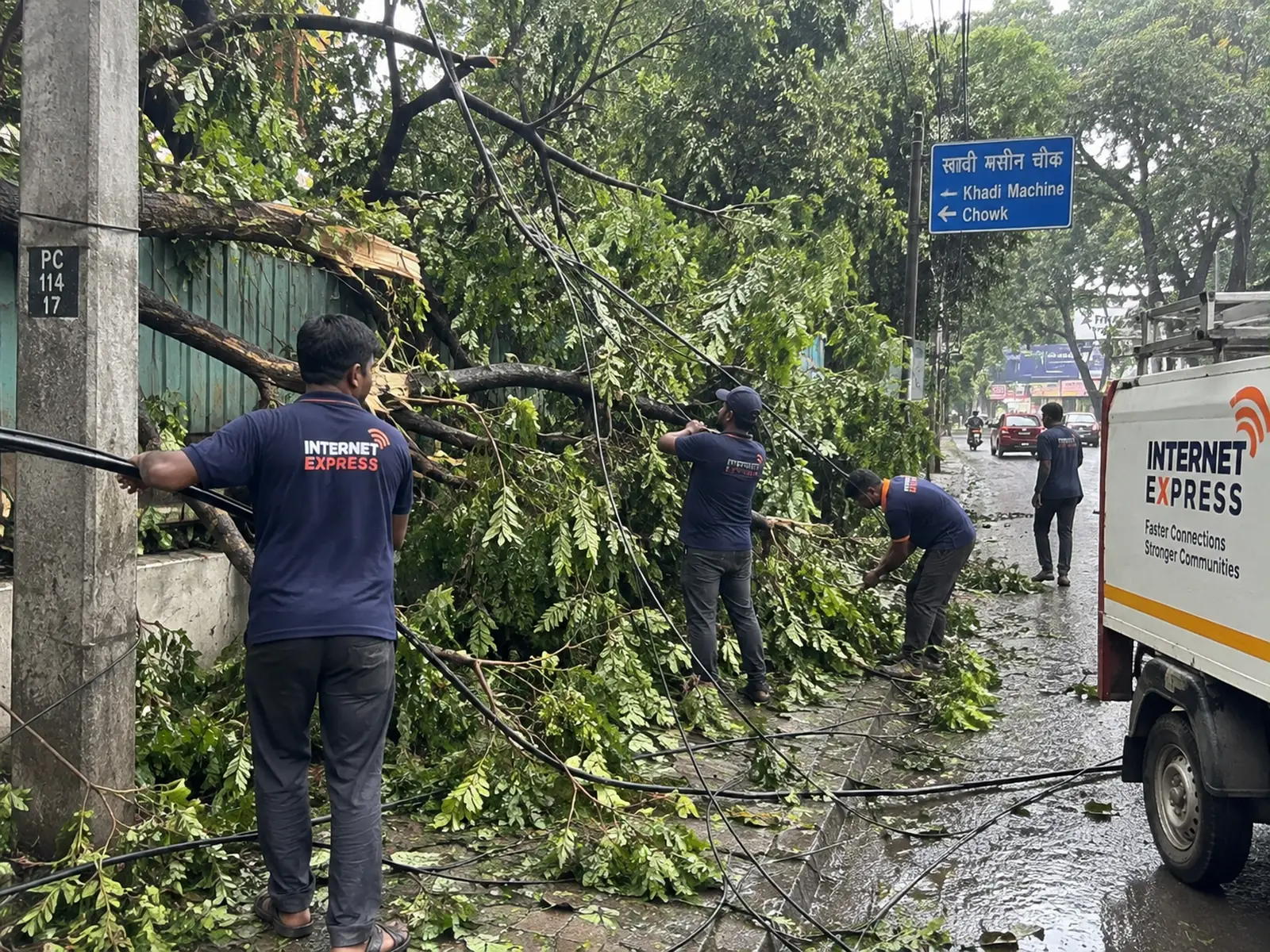
Then someone has to go and look. Sometimes the cause is obvious: a fallen tree, a fresh trench, a pole lying on its side. Sometimes the damage is a crushed section inside an intact-looking cable.
Stage 3 — Access and splicing
This is the stage that usually decides how long an outage lasts, and most of it is not the splice itself.
- Getting to the cable. A branch may need to be cleared, a trench may belong to another contractor, a pole may need to be made safe, or traffic may need to be managed on a busy road.
- Preparing the ends. The damaged section is cut back to clean fibre on both sides. If too much is damaged, a new length of cable is laid in.
- Fusion splicing. Each glass strand is aligned with its partner and fused with an electric arc. A feeder cable carries many strands, and each one has to be joined individually, then protected and closed in a joint enclosure.
So a break on a single drop to one building can be quick, while a break in a large feeder cable in a difficult location can take much longer. Access — waiting for a tree to be cleared or for a trench to be made safe — is very often the reason a repair is taking hours.
Stage 4 — Testing and restoration
After splicing, the path is tested to confirm light is passing cleanly through each joint. Services come back as the fibres are restored, and the NOC confirms that equipment on the far side has reconnected. If the break was on a protected ring span, the repair also restores the network's alternate path, so the next fault can be absorbed again.
Occasionally a connection does not come back by itself after a repair, usually because home equipment needs a restart. If your service has not returned when your neighbours' has, the right power-cycle order is: fibre box on first, wait two minutes, then the router.
Why we do not promise a fixed repair time
Because the slowest stage depends on things outside the network — site access, weather, other contractors, traffic — we do not publish a fixed restoration time for physical cuts. What we do publish is how quickly support comes back to you with a resolution or a clear next step, in the escalation path, and how eligible downtime is credited under the downtime-credit policy.
What helps a repair go faster
- Report as soon as the connection drops, with your registered mobile number and address.
- Tell us what you can see: a fallen branch, digging, pole work.
- Note the fibre-box light colours — a red or flashing LOS light usually means the break is outside your home.
Every repair follows the same four stages. Detection and testing are fast; locating the break is usually quick; access is the stage that sets the clock. Need help right now? Contact support.