Tree Cutting, Monsoon and Your Broadband: The Most Preventable Fibre Cut in Pune
A branch dropped onto a cable span can take a neighbourhood offline for hours. Why fibre breaks differently from the cable beside it, and what actually prevents tree-related cuts in Pune.
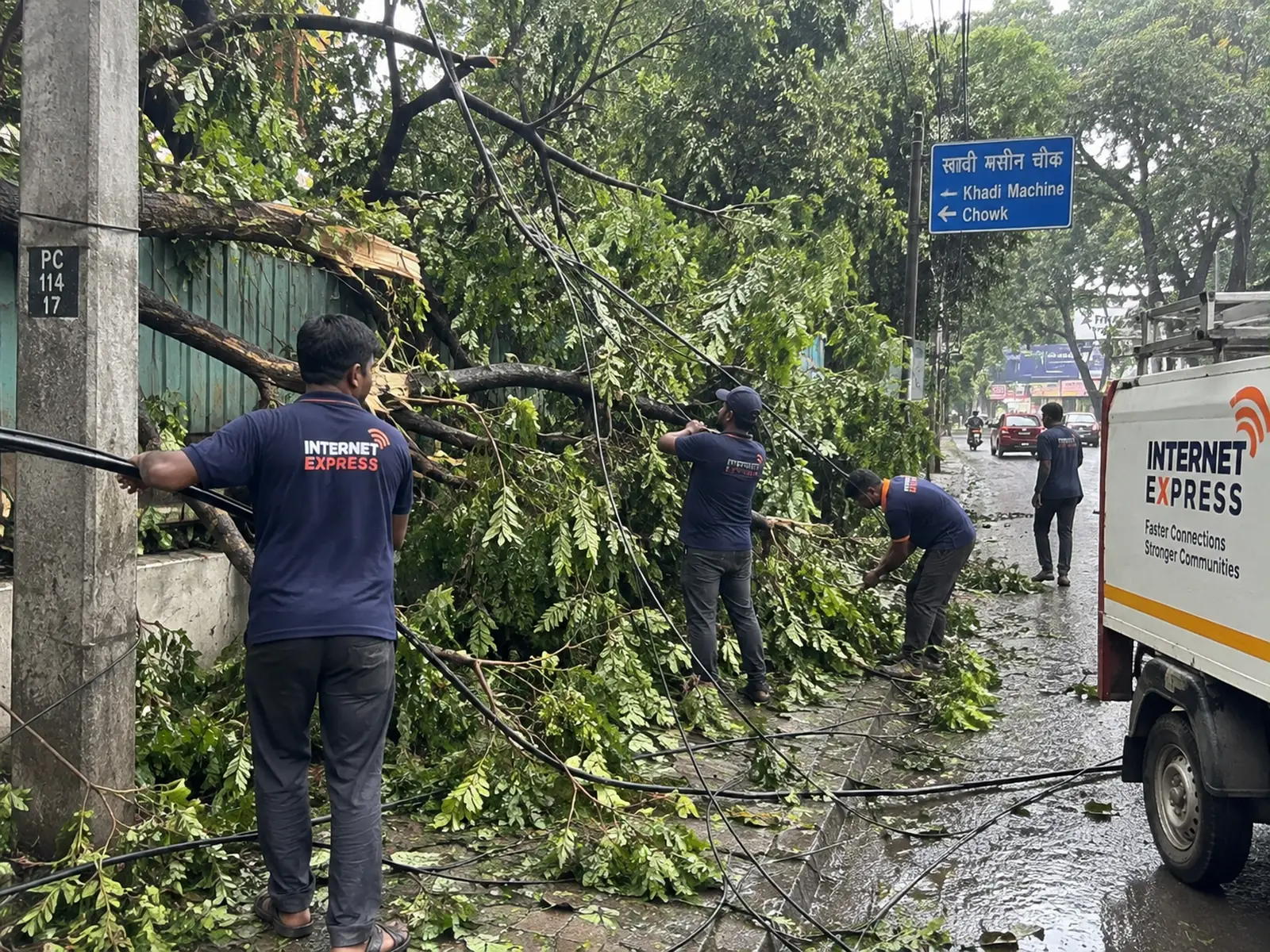
Every monsoon, and every time trees along a road are trimmed, someone somewhere in Pune loses their broadband because a branch landed on a cable. It is the most frustrating kind of outage because it is almost always avoidable. A cable that would have survived with twenty minutes of notice ends up needing a crew, a ladder and a splice.
Why a branch does so much damage
Much of the telecom cable in Pune and Pimpri-Chinchwad runs overhead — on poles, and in many older streets alongside or through tree canopy. A copper or power cable beside it can often take a heavy knock, bend and carry on working. Optical fibre is different. The cable's outer jacket is tough, but the signal travels through strands of glass inside it. Bend those strands too tightly, or crush them, and light stops getting through, even when the cable looks undamaged from the ground.
So a branch does not need to snap the cable to cause an outage. Pinning it against a pole, dragging it into a tight curve or pulling it off its clamp is enough.
The two ways it happens
Trimming and felling
Planned tree trimming along roads, and felling for construction or road widening, is the larger share. Cutters work from the ground or a crane and drop branches straight down — onto whatever runs beneath. Nobody sets out to cut a cable; the cable is simply in the way of a job that has its own deadline.
Monsoon falls
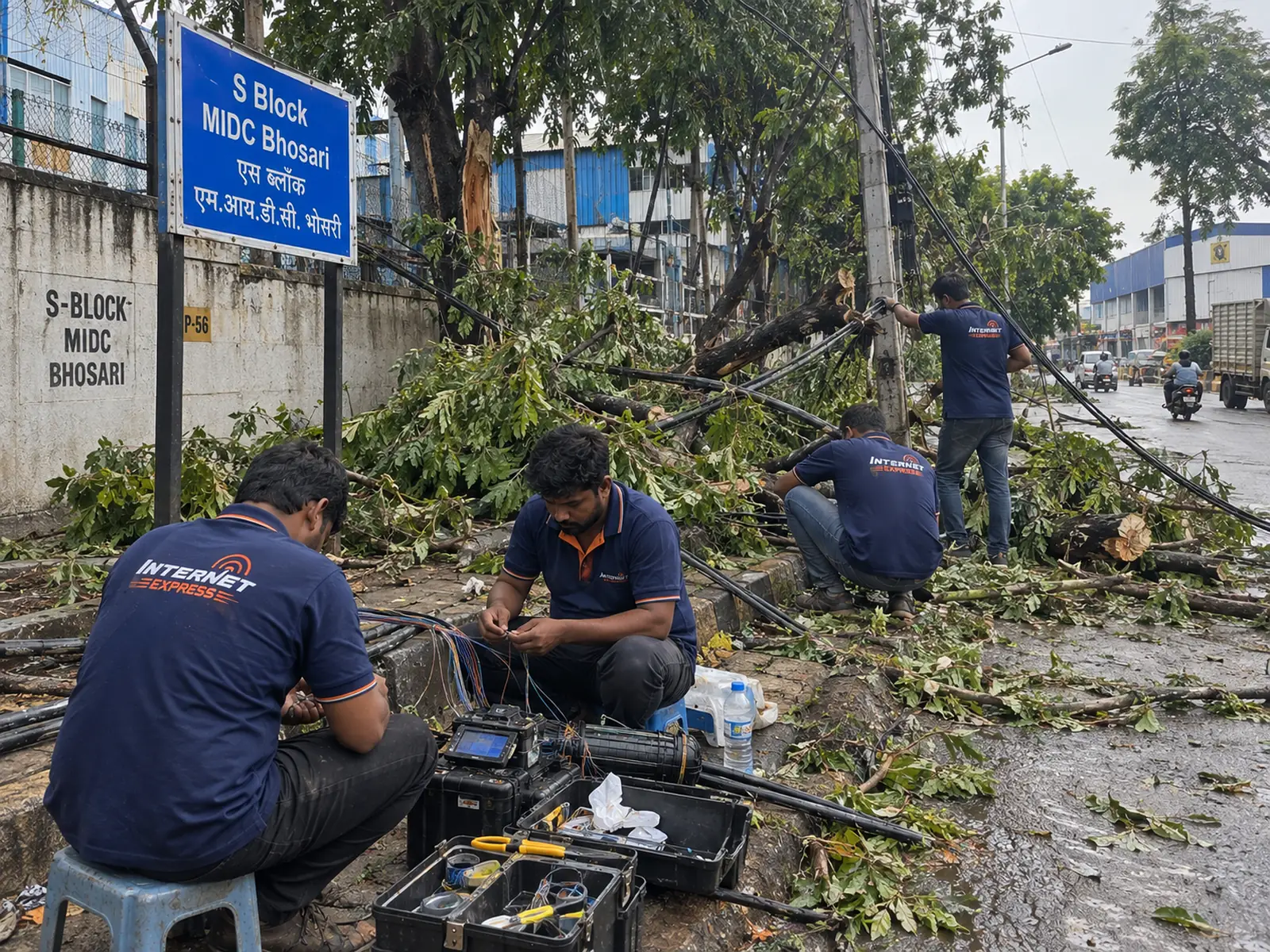
Heavy rain and wind bring branches down with no warning at all. Saturated wood is heavier, and a single large limb across a span is enough to break the fibre inside. Monsoon falls tend to cluster: one storm evening can produce several separate breaks across a neighbourhood.
Why it takes hours, not minutes
Most of the time is not the splice. A fibre repair has several stages — detecting the break, locating it, making the site safe, splicing and testing — and we describe them in what actually happens when a fibre is cut. With a fallen tree there is an extra step before any of that: the branch has to be cleared, sometimes by the civic body, before anyone can safely reach the cable. On a busy road, traffic and access add more time.
What actually prevents it
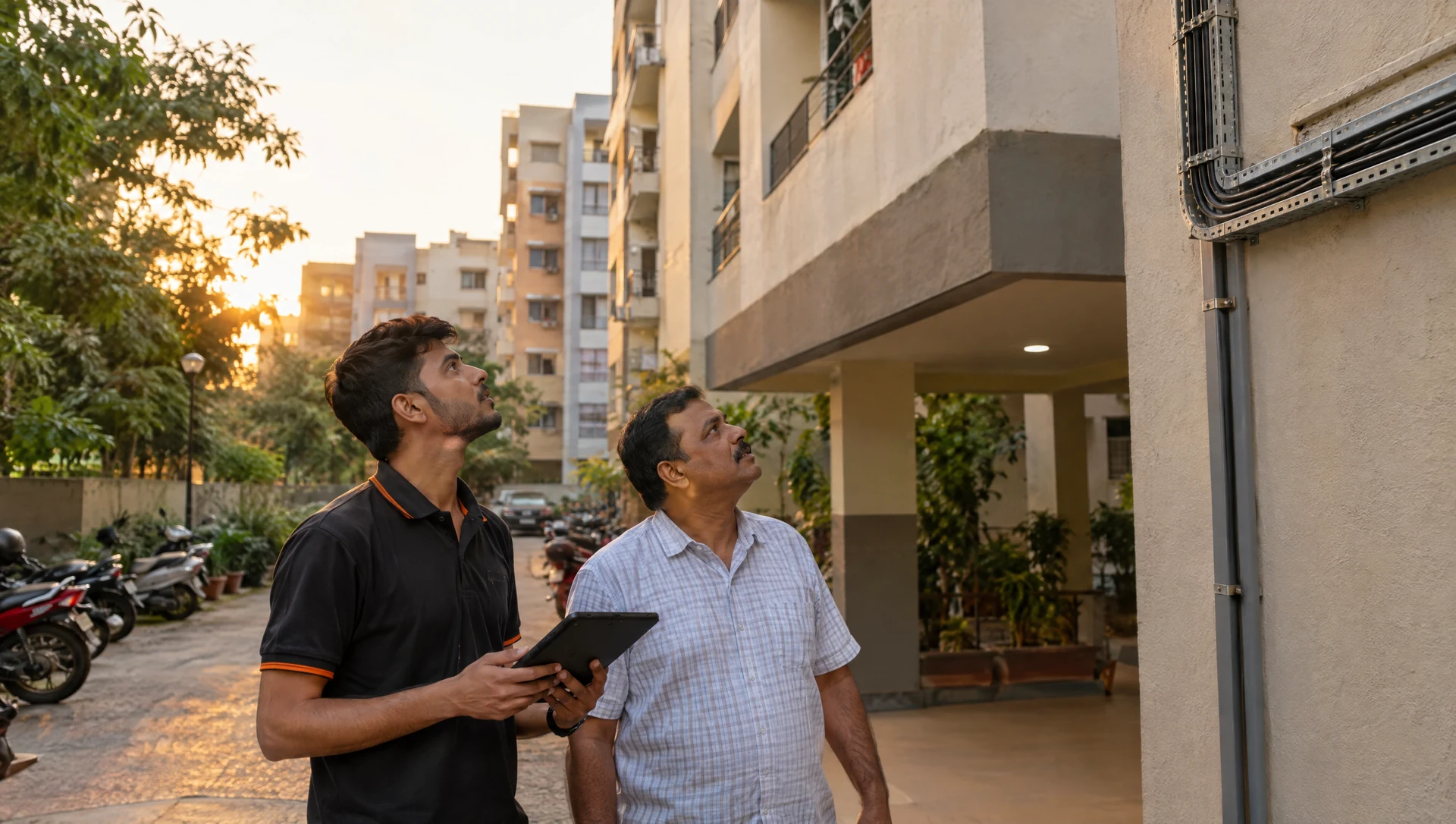
- Notice before trimming. This is the single biggest factor. With a short warning, a crew can lower or protect a span before the cutters start, then re-hang it afterwards. We actively ask societies, contractors and ward offices to tell us before tree work near our cables.
- Routing away from canopy where possible. When spans are rebuilt, we route them to reduce the length that passes under or through trees. In some streets there is simply no other path, and that is where early notice matters most.
- Proper clamps and sag. A cable hung with the right tension and clamps is more likely to shed a light branch than one that is slack and snags.
- Pre-monsoon walks. Checking spans that sit under heavy branches before the rains lets overhanging limbs be reported and dealt with while it is still dry.
- Protected rings in the shared network. Where a fall hits a protected span, traffic can take the other direction round the ring while the repair happens. It does not help on the single drop into one building.
How you can help
If you see tree work starting on your street, or a branch hanging on a cable after a storm, send a message to our support WhatsApp with the location. A photo helps. It takes thirty seconds and it is genuinely the most useful thing a neighbour can do — it often means the cable is protected before it breaks, or the repair crew knows exactly where to go.
And if your connection does drop during a storm, report it straight away. The ticket starts the clock, lets us group reports from the same street into one fault, and is what any downtime credit is calculated from.
The short version
Tree-related cuts are common, slow to fix and mostly preventable. The fix is less about technology and more about notice: a few minutes of warning before trimming saves hours of outage afterwards. If you manage a society or a commercial building and plan tree work, let us know in advance — we will send someone to protect the cable.