Why Fibre Cuts Keep Happening in MIDC Bhosari — and What We Changed
Municipal digging, MSEB pole work and tree cutting all get called a cable cut. What actually breaks fibre in Bhosari MIDC, and the four changes that make a cut cost you less time.
If your office is in Bhosari MIDC, you have probably heard the phrase "cable cut" more often than you would like. It sounds like one problem. It is actually three different ones, with different causes, different warning signs and different fixes. Understanding which one you are dealing with explains why some outages last forty minutes and others last an afternoon.
Why MIDC is harder than a housing society
Most of the fibre that serves the industrial estate does not run underground. It runs overhead — on MSEB distribution poles and, in places, along trees that line the main roads. The estate is laid out along long, straight road corridors, and there is often no second physical route to take a cable around a problem stretch. Underground ducting would be the textbook answer, but the roads are dug so often for other utilities that a duct is not automatically safer.
That combination — aerial cable, busy roads, heavy vehicles and constant utility work — is why the estate sees more physical damage than a quiet residential lane.
The three things people call a "cable cut"
1. Road and utility digging
Drainage, water lines, road widening and other contractors' trenching are the classic cause of an underground break. An excavator bucket does not distinguish between a telecom duct and loose soil. These breaks are sudden, usually affect everything on that route at once, and the repair depends on getting access to a trench that somebody else controls.
2. MSEB pole work
When distribution poles are replaced, shifted or re-cabled, the telecom cable carried on them has to come down or be moved. Done with notice, that is a planned job. Done without notice, the cable is cut or pulled loose so the pole work can continue. Pole-related damage often looks like a clean cut at one point, or a span that has been dragged and stressed over a long length.
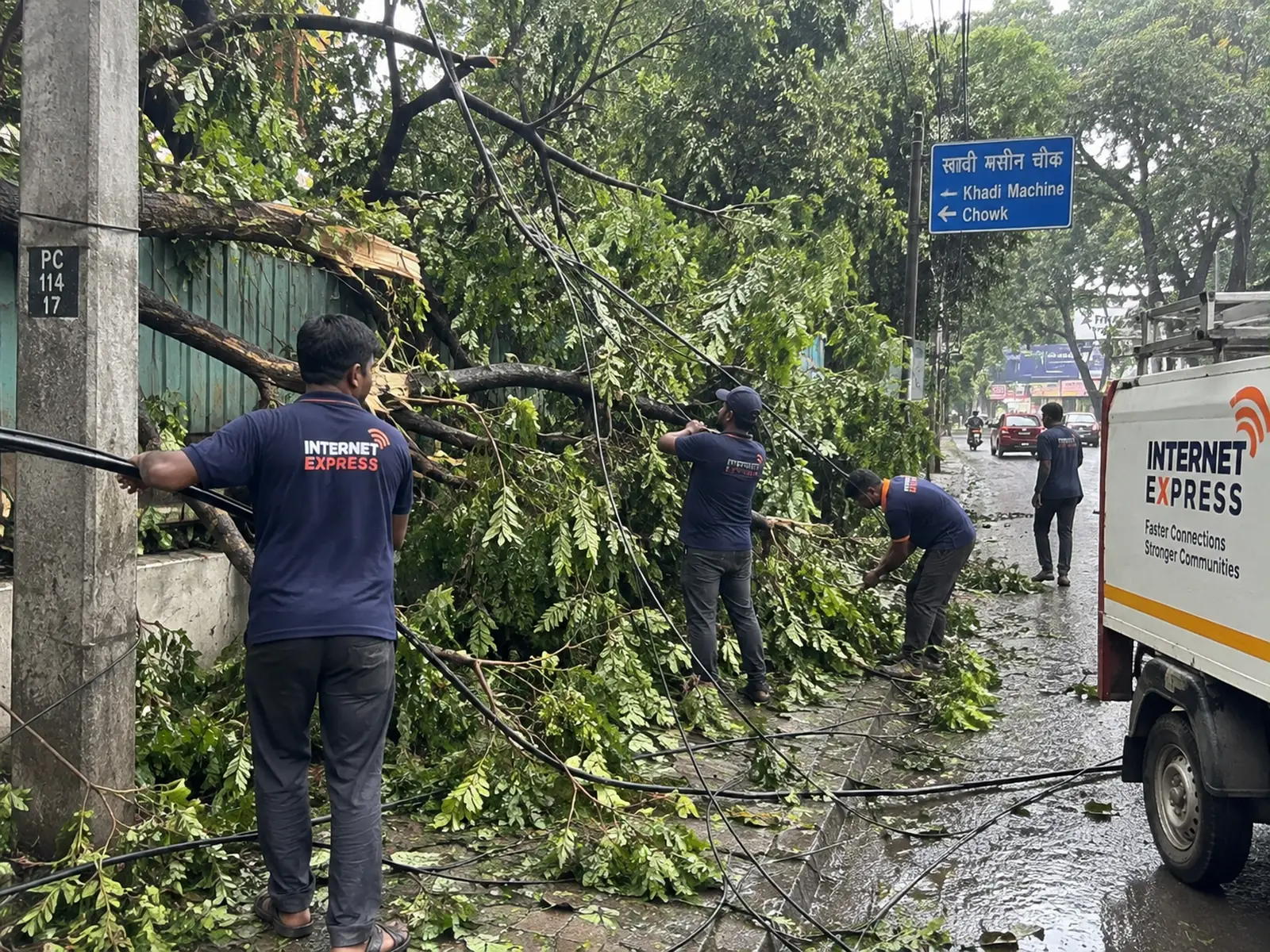
3. Tree cutting and falling branches
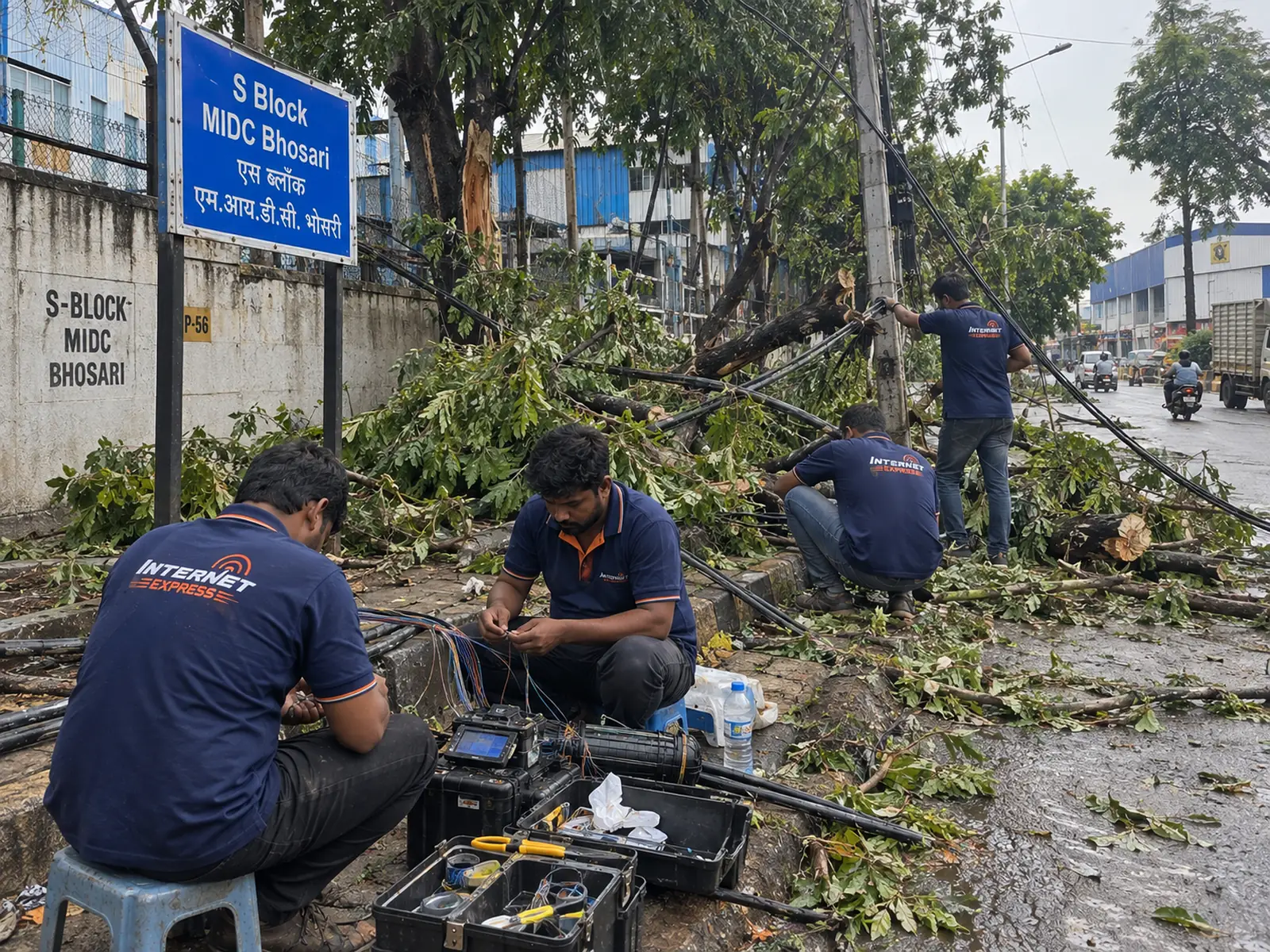
Tree trimming along the main roads, and monsoon branch-falls, bring down aerial spans. A single heavy branch across a span can snap the cable or bend it so sharply that the glass inside breaks even though the outer jacket looks intact. We have written separately about why tree-related cuts are the most preventable of all.
What we changed
We cannot stop other people digging or trimming. What we can change is how much of the network one incident takes down, and how long it takes to find and fix. These are the four changes that matter most.
Rings instead of single lines
The shared network is built as rings rather than straight lines. Where a break falls on a protected span, traffic can travel the other way round the loop instead of stopping. That does not remove the need to repair the cable — a cut is still a cut — but it can turn a site-wide outage into a repair job that happens while customers stay online. The honest limit: the final stretch into an individual building is a single path, so a break on that last drop still needs a physical repair. How ring protection works, and what it does not do.
Spare capacity inside every feeder
Feeder cables are specified with spare fibre cores kept free rather than lit on day one. When one core is damaged at a joint, or a splice degrades, service can be moved to a spare core instead of waiting for a fresh cable to be pulled.
Finding the fault before driving to it
The network operations centre watches equipment and link signals around the clock. When a span drops, the affected section is usually visible before the first customer calls. Engineers then use optical testing to narrow the break to a stretch of road, so the team arrives at the right pole instead of walking the corridor looking for it. That step alone is often the difference between a short outage and a long one.
Engineers who already work on these roads
The people who repair the MIDC network are based in Pimpri-Chinchwad and work these corridors every day. There is no regional dispatch queue. They know which spans run on which poles, where the trees overhang, and which contractors are working where this week.
What you can do if you run a business in the estate
- Report immediately. Raise a ticket as soon as the connection drops, even if you think we already know. The ticket is also what any downtime credit is calculated from.
- Tell us about work you can see. If a contractor is digging or MSEB is replacing a pole near your unit, a quick WhatsApp to support often lets us protect the cable before it is damaged.
- Consider a second path if an hour offline costs real money. For premises where downtime is expensive, a backup link on a different route is worth discussing. Business connectivity in MIDC explains the options.
The short version
Cuts in MIDC are mostly caused by other work on the same roads. We cannot make the roads quiet, but a ring-based network, spare cores, fast fault location and a local repair team mean a cut costs you as little time as the physical repair allows. If you are in the estate and want to know how your own premises are connected, talk to our local team.